A DEKENEAS Digital Risk Protection case study: two early warnings, one business email compromise.
In brief
A partner of a Romanian manufacturing company was asked to send USD 120,000 to a new bank account. The request came as a reply in a real email conversation, from an address that looked almost exactly like the company's own. It was fraud, and the partner did not pay.
The partner caught it because the company had been warned in advance. DEKENEAS spotted two separate pieces of the attack while they were still being prepared, days before the fake request was sent.
The first warning came when a company employee's email password appeared in a closed criminal chat channel. The second came three days later, when someone registered a web address that imitated the company's own. Two days after that, the fake address was set up to handle email, and DEKENEAS raised the alarm further. The company told its partners that the address was not genuine. When the fraudulent request arrived, the partner recognised it.
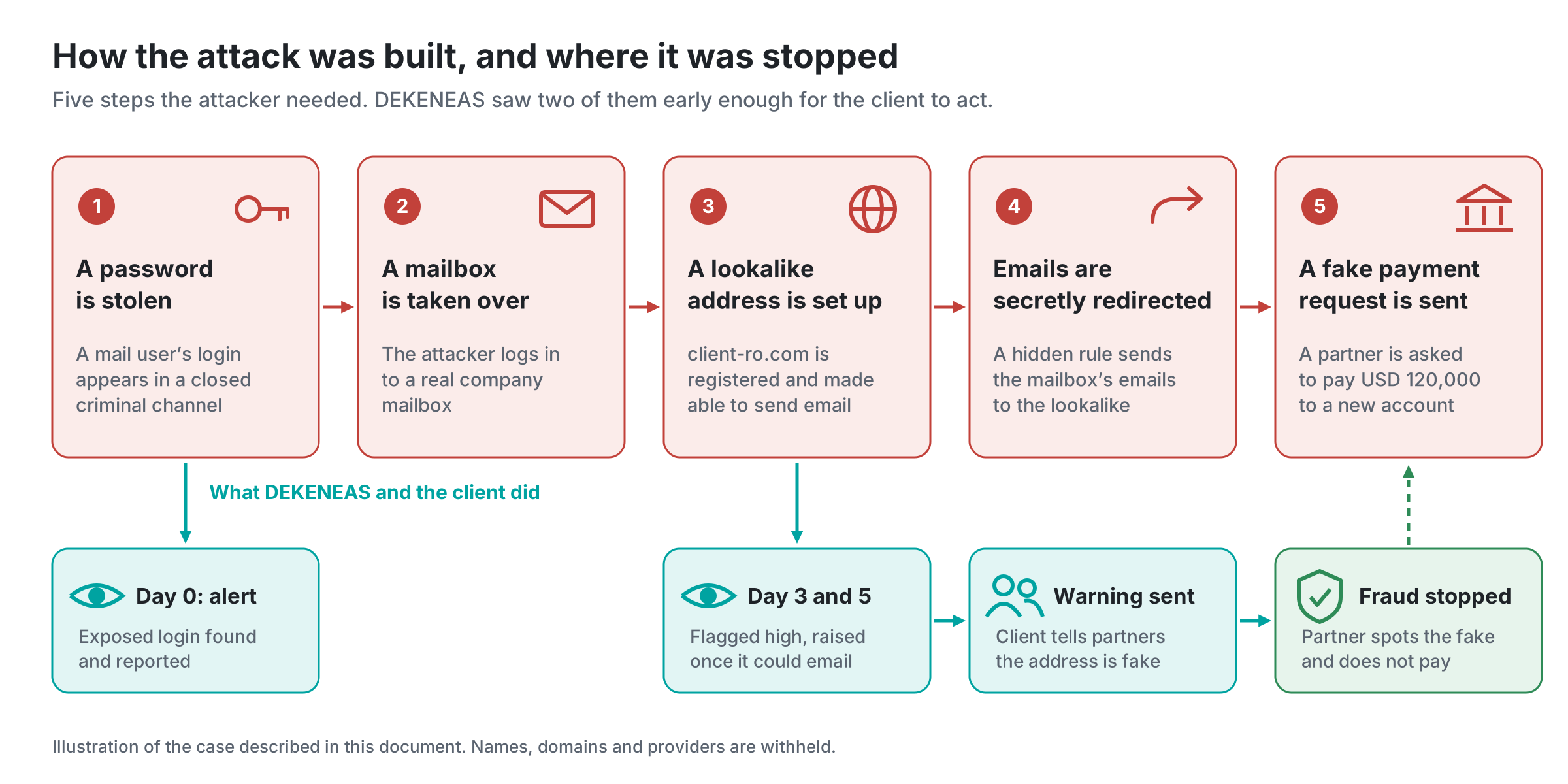
| Type of attack | Business email compromise: a taken-over mailbox, secretly redirected emails, and a request to change bank details |
|---|---|
| Fake address | client-ro.com, imitating the company's real client.ro |
| First warning | Day 0: an employee's email login found in a closed criminal chat channel |
| Second warning | Day 3: the fake address flagged as high risk when registered. Day 5: risk raised again when it was set up for email |
| Amount at risk | USD 120,000 |
| Outcome | The partner recognised the fraud and did not change the payment details |
Names, real addresses and service providers are withheld at the client's request. Throughout this document, client.ro stands for the company's real address and client-ro.com for the fake one.
Why this kind of fraud matters
The fraud attempted here has a name: business email compromise, usually shortened to BEC. It is one of the most costly forms of cybercrime in the world. In 2025, the FBI's Internet Crime Complaint Center recorded USD 3.05 billion in reported BEC losses. Reported losses from account takeover, the method used to break into the mailbox in this case, reached a further USD 359.7 million.
These attacks rarely start with anything dramatic. There is no virus that crashes computers and no ransom note. There is only a stolen password, a cleverly chosen web address, and a polite email that asks for something that sounds routine. Because each step looks ordinary on its own, these attacks are hard to spot from inside a company. Most of the preparation happens on the open internet and in criminal spaces that a company's own security tools never see.
That outside space is what DEKENEAS watches.
The ideas behind this case, in plain language
This section explains the terms used in the rest of the case study. Each term is collapsed — click a title to open it.
Domains: the name behind every email address
Every company email address has two parts. In accounts@client.ro, the part before the @ is the mailbox, and the part after it, client.ro, is the domain. The domain is the company's name on the internet. It appears in its website address and in every email its staff send.
Anyone can register a new domain in a few minutes, for a few euros, through a company called a registrar. Registrars check very little about who is buying a name or why.
Lookalike domains
A lookalike domain is a web address registered by someone else to look like a real company's own. Criminals use lookalikes to send emails that appear to come from a company, or to host fake websites that copy a company's real one.
Some lookalikes swap letters (c1ient.ro with the number one instead of an L). Others add words (client-payments.ro), use a different ending (client.com instead of client.ro), or combine several tricks. In this case, the attacker used a combination: the country code "ro" was moved into the name with a hyphen, and the address was given a .com ending.
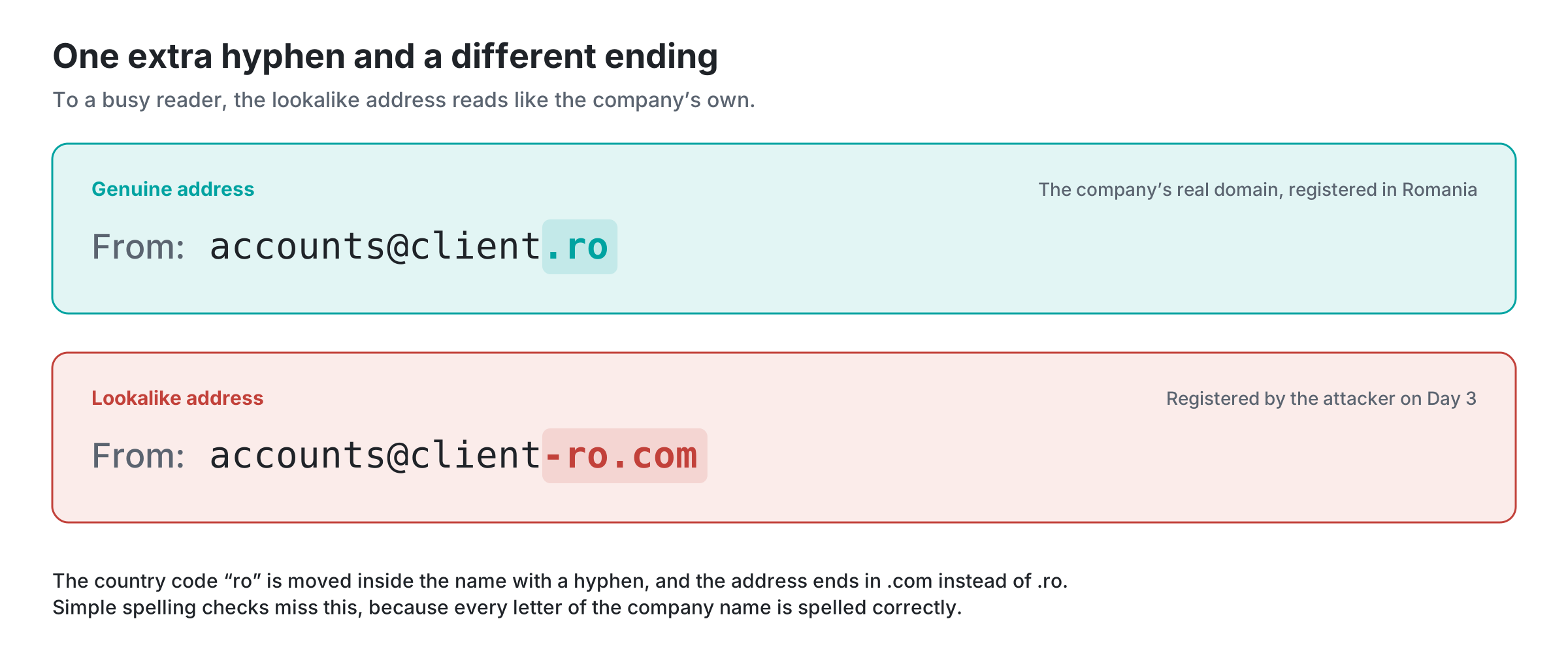
To someone reading quickly, client-ro.com looks like a natural variant of the company's own name. Every letter of the company name is spelled correctly, so simple spelling checks miss it.
MX records: giving an address a postbox
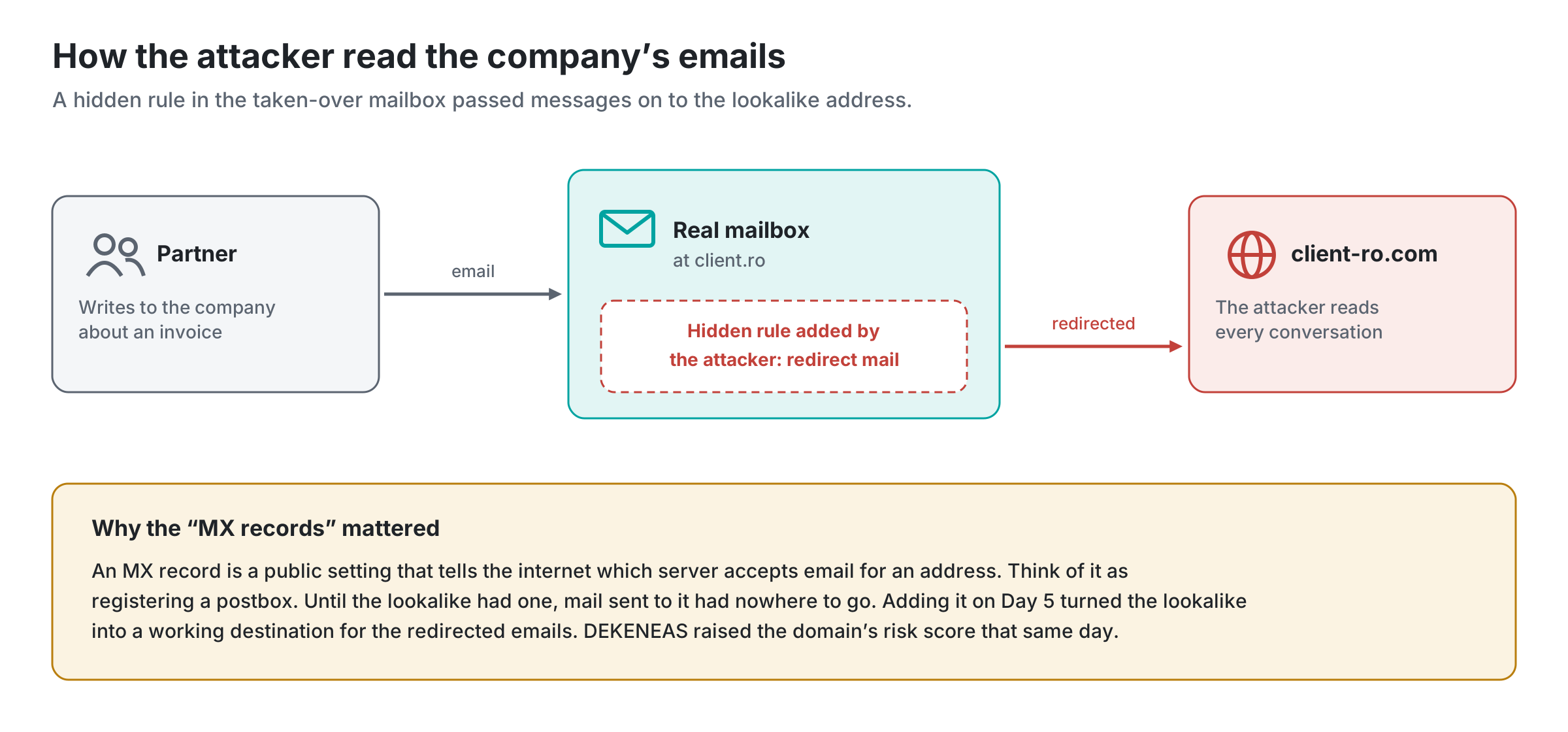
A newly registered domain cannot receive email until its owner publishes an MX record. MX stands for "mail exchange". It is a public setting that tells the rest of the internet which server should receive emails sent to that domain.
A useful way to think about it: registering a domain is like putting a name on a building, and adding an MX record is like installing a postbox at the door. Until the postbox exists, letters addressed to the building have nowhere to go.
This matters because many security tools only look for fake websites. A lookalike domain with no website but a working postbox can still be used to receive stolen emails and to send fraudulent ones. It simply does not show up in a website search.
Credentials and how they are stolen
Credentials are the details someone uses to log in to an account, usually an email address or username together with a password. Whoever holds a person's credentials can usually log in as that person.
Credentials are stolen in several common ways:
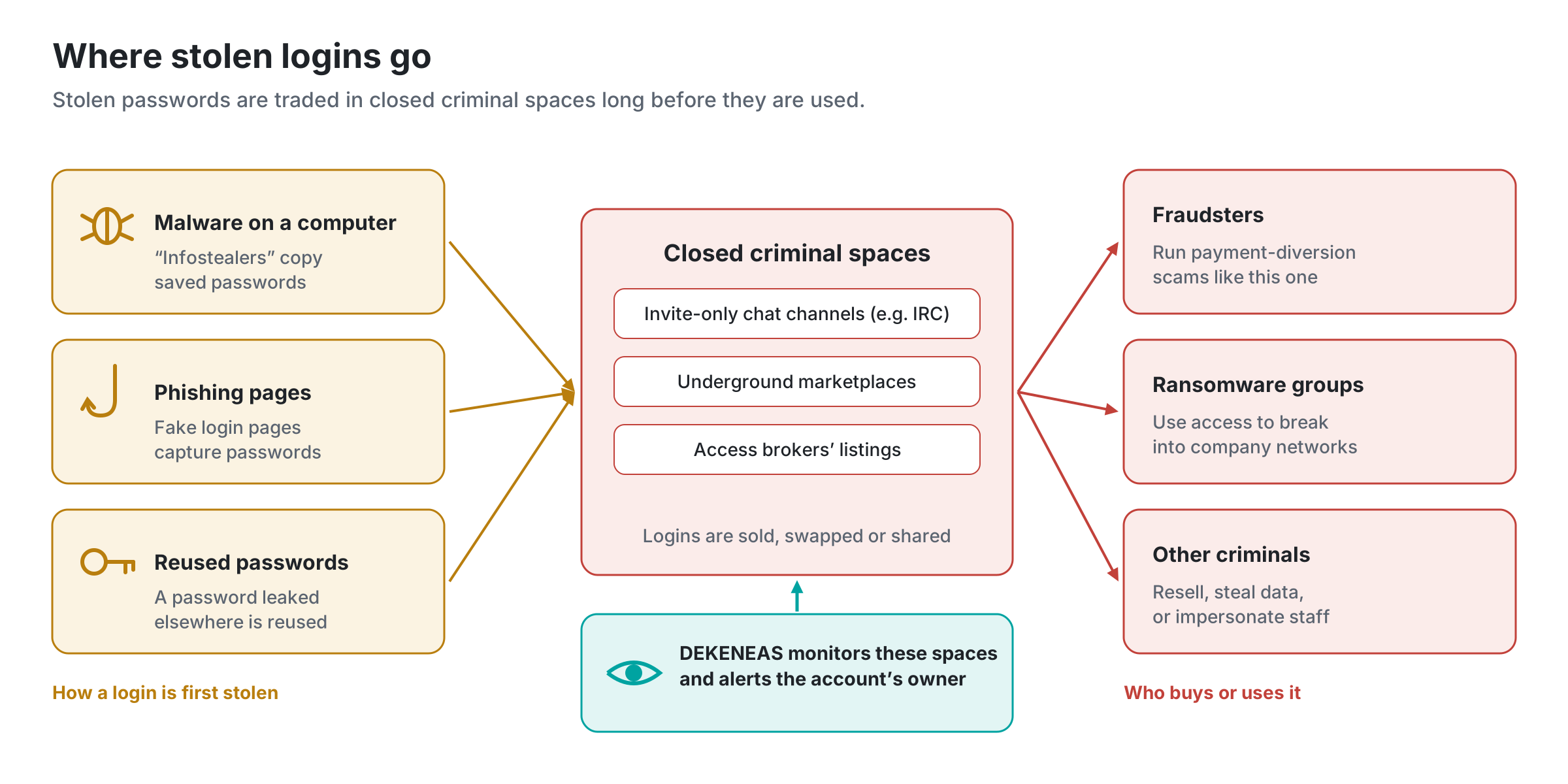
- Infostealer malware: malicious software, often hidden in pirated programs or fake downloads, that quietly copies every password saved in a computer's web browser and sends them to criminals.
- Phishing: fake login pages, sent by email or text message, that trick people into typing their password.
- Password reuse: when someone uses the same password on several sites, a leak from one site gives criminals the key to the others.
In this case, how the employee's password was originally stolen is not known. What is known is where it surfaced next.
Threat-actor marketplaces and closed channels
A threat actor is the security industry's term for anyone carrying out attacks: an individual criminal, an organised gang, or a group sponsored by a state.
Stolen credentials rarely stay with the person who stole them. They are traded in an underground economy that works much like a legitimate market. Underground marketplaces are websites, often reachable only through special anonymising software, where stolen logins, credit card numbers and access to company systems are bought and sold. Closed channels are private, invite-only chat rooms where criminals share and sell the same kinds of material. Many still run on IRC (Internet Relay Chat), a chat system that dates back to the late 1980s and remains popular because it is simple and hard to monitor.
These spaces are deliberately hard to get into. Ordinary search engines and public breach-checking websites do not reach them.
Initial access sales and access brokers
Some criminals specialise in getting in, not in what happens next. These initial access brokers break into company accounts or networks and then sell that access to others. A buyer might be a ransomware group that wants to lock the company's systems, or a fraudster who wants to read its email.
An initial access sale is that transaction: an advertisement or deal offering a way into a specific organisation, sometimes naming its industry, country or size. A single stolen email login can be the product.
According to Verizon's 2026 Data Breach Investigations Report, 73% of ransomware victims had an infostealer infection or a credential leak in the year before the attack. For half of them, the gap between the leak and the attack was 95 days or more. That window is when outside monitoring can make a difference.
Account takeover
Account takeover is what happens when a criminal uses stolen credentials to log in to a real person's account and act as them. From the outside, nothing looks wrong. The account is genuine, the login uses the correct password, and the messages come from the real address.
In an email account, a takeover gives the attacker access to every past conversation and every new message. Attackers often quietly add a hidden forwarding or redirection rule, a setting that automatically sends incoming emails on to an address the attacker controls. The real owner may notice nothing at all. Such rules can also keep working after the password is changed, unless someone checks for them and removes them.
Business email compromise
Business email compromise (BEC) is fraud carried out by impersonating someone a business trusts, by email, to get money or sensitive information. Common versions include:
- Invoice and supplier fraud: a "supplier" announces new bank details so that the next payment goes to the criminal.
- Executive impersonation: a "director" urgently asks a member of staff to make a confidential transfer.
- Payroll diversion: an "employee" asks HR to pay their salary into a new account.
The case in this study is the first type. The request to change an IBAN (International Bank Account Number, the code that identifies a bank account for transfers) is one of the most common BEC requests. The most convincing versions arrive as replies inside real conversations, because the attacker has been reading those conversations through a taken-over mailbox.
Registrars, bulletproof hosting and takedowns
When a lookalike domain is found, the usual response is a takedown: asking the registrar that sold the domain, or the hosting company that runs its servers, to switch it off. Most providers act on well-evidenced reports.
Some do not. A small number of registrars are known for tolerating abuse and responding slowly to complaints. Bulletproof hosting providers go further. They market themselves to criminals and deliberately ignore takedown requests. A lookalike on bulletproof hosting can stay online for weeks or longer, so warning the people it targets becomes the fastest protection available. The lookalike in this case used both a lenient registrar and bulletproof hosting.
The client
The client is a Romanian manufacturing company that pays and is paid by an established network of partners, suppliers and customers. Payments between these businesses are regular, often large, and arranged by email.
DEKENEAS provides the client's digital risk protection: monitoring the outside internet and criminal spaces for threats aimed at the company. Fixing problems inside the company's own systems, such as securing a mailbox, is the job of the client's internal security team.
What happened, step by step
Day 0: a password appears in a criminal channel
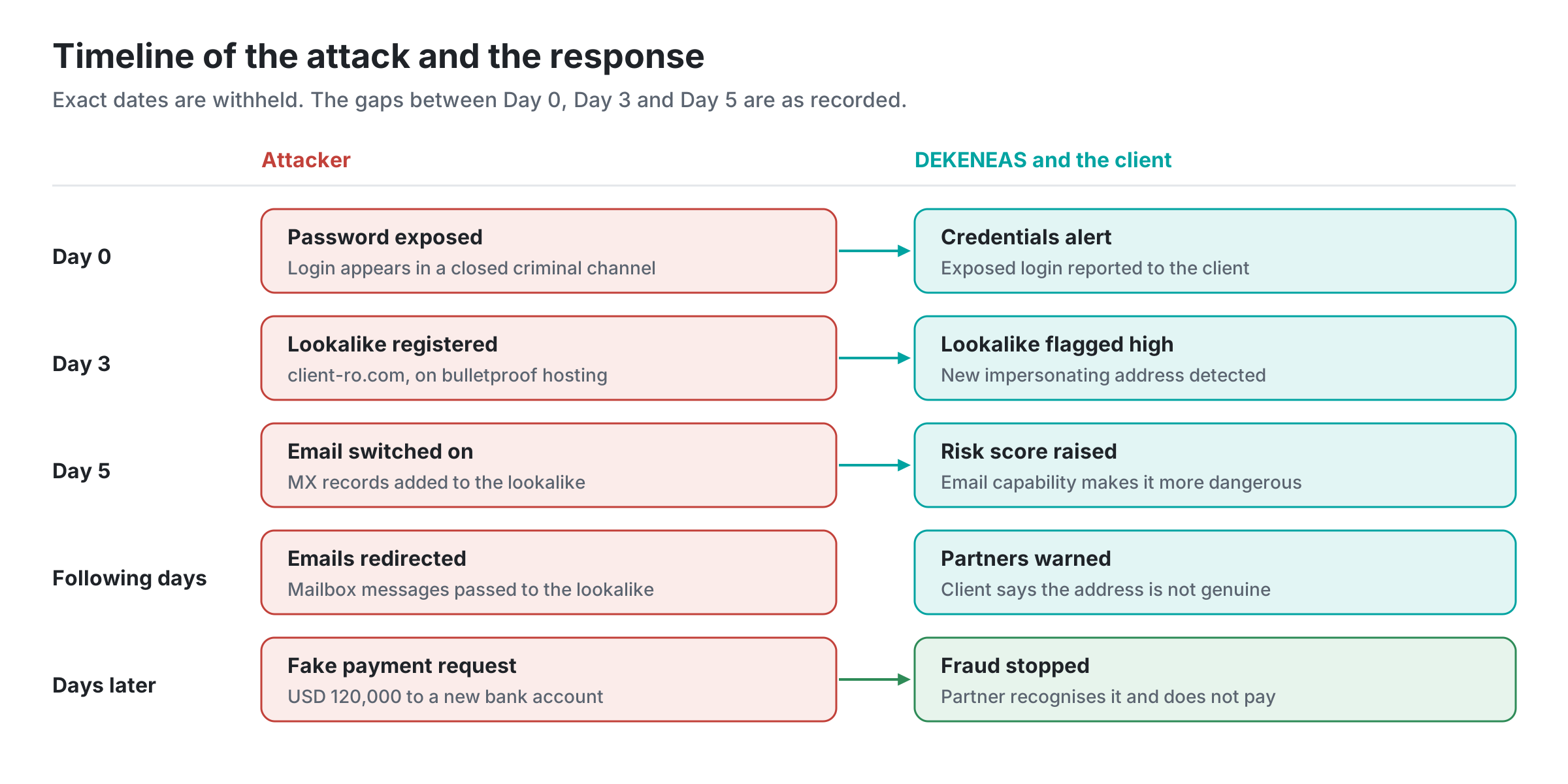
DEKENEAS found the email login of one of the company's employees in a closed IRC channel used by threat actors. This kind of source is invisible to public breach databases and search engines. DEKENEAS covers it through human intelligence, meaning analysts who monitor these criminal communities directly.
The client received the finding as an alert in the DEKENEAS console. Nobody at the company had to enter the channel or deal with criminals. On its own, one exposed password can look routine. Its real significance became clear over the next five days.
Day 3: a lookalike address is registered
Three days after the password appeared, someone registered client-ro.com. DEKENEAS detected the new domain and flagged it as high risk the same day.
Several warning signs pointed the same way:
- It imitated the company: the full company name and its country code were built into the address.
- It was brand new: the domain was only days old.
- Its registrar: the domain was registered through a registrar with a record of tolerating abuse.
- Its hosting: it ran on bulletproof hosting, built to resist takedowns.
There was no website on it, and there never needed to be. A tool that only searched for fake websites would have seen nothing.
Day 5: the lookalike gets a postbox
On Day 5, MX records were added to client-ro.com. From that moment, the fake address could receive email. DEKENEAS raised the domain's risk score again, because a lookalike that can handle email is far more dangerous than one that cannot.
This was more than a general warning sign. Using the stolen password, the attacker set up a hidden rule in the employee's real mailbox that redirected its emails to client-ro.com. That only works if the fake address can receive mail, which is exactly what the Day 5 change made possible. From then on, the attacker could read the company's conversations with its partners and wait for the right moment to act.
The following days: the client warns its partners
After DEKENEAS flagged the lookalike, the company warned its partners and customers that client-ro.com was not a company address and that any message from it should be treated as fraudulent. Because the domain sat on bulletproof hosting, getting it removed quickly was unlikely. Warning the people the attacker would target was the fastest defence available.
Days later: the fraudulent request
A few days later, one of the company's partners received an email from client-ro.com. It was presented as a reply within a genuine, ongoing conversation about a payment, and it asked the partner to send USD 120,000 to a new bank account.
Everything about the email was designed to be believed: the right people, the right conversation, the right moment in a real business process. The only thing wrong was the address it came from, and the partner had already been told to look for it. The partner recognised the request as fraud and did not change the payment details.
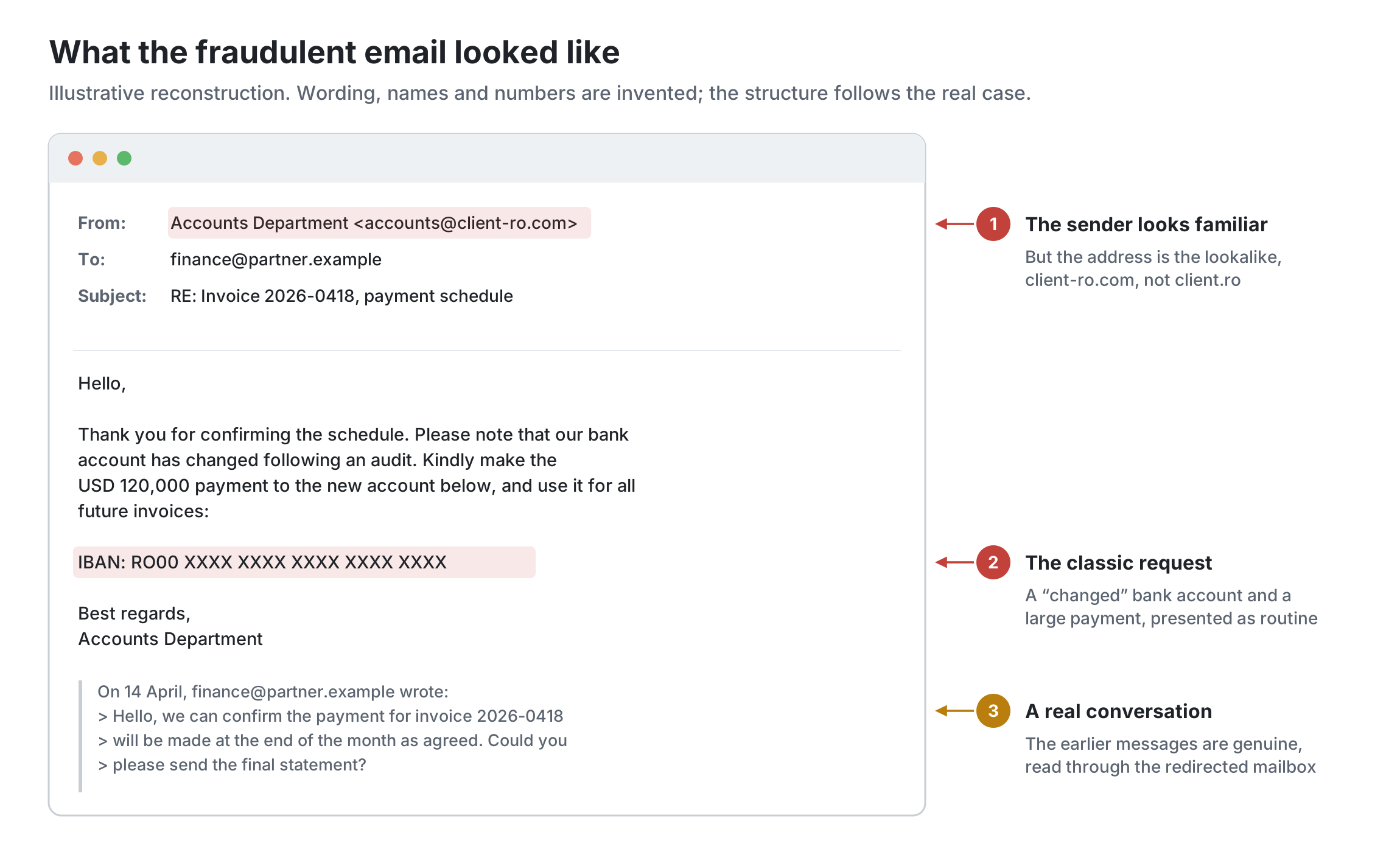
The image above is an illustrative reconstruction. The wording, names, dates and account number are invented to show how such an email typically looks. The real email is not reproduced.
Why the two warnings mattered together
Each of the two DEKENEAS findings, taken alone, describes something that happens often: a leaked password, or a newly registered lookalike address. Together they describe one operation, with a way in and a way out.
The way in was the stolen password, which gave the attacker control of a real mailbox. The way out was the lookalike address, which received the redirected conversations and then sent the fraudulent reply.
DEKENEAS rates findings from all of its monitoring areas on the same low, medium, high and critical scale, in one console. A leaked password from a criminal channel and a suspicious new domain can be read side by side. A company does not have to piece together reports from separate tools to see that they belong to the same attack.
What this case does and does not show
Being precise about what monitoring can and cannot do makes the lessons more useful.
DEKENEAS watches the outside internet and criminal spaces. It cannot see inside a company's mailboxes, so it did not see the hidden redirection rule itself. What it saw were the two outside signs of the attack: the exposed password and the email-ready lookalike. How the employee's password was originally stolen is also not known. How the client's own security team handled the compromised mailbox is outside the scope of this case study.
What the case does show is timing. Both warnings came before the fraudulent email was sent, and early enough for the client to act.
Lessons for business leaders
- A fake address with no website is still a weapon. In this case, a working postbox was enough to steal conversations and send the fraud. Protection that only looks for fake websites would have missed this domain entirely.
- Attacks show themselves early, and outside your walls. The stolen password surfaced in a criminal channel before the fake address even existed. Seeing both signs, and connecting them, turned two routine alerts into a clear picture.
- Closed criminal spaces matter. The password appeared in an invite-only channel, not in a public leak that anyone could search.
- When removal is slow, warnings protect people. Bulletproof hosting resists takedowns, so telling partners which address to distrust protected them while enforcement ran its course.
- A password alert calls for more than a password reset. Forwarding and redirection rules created with stolen credentials can survive a password change. The affected mailbox's rules should be checked and cleaned too.
Practical steps for finance and operations teams
These habits stop most payment-diversion fraud, whether or not an attack has been detected in advance:
- Verify every change of bank details by phone, using a number you already have on file, never one given in the email that asks for the change.
- Treat urgency and confidentiality as warning signs. Requests to pay quickly, quietly, or "before the end of the day" deserve a second check.
- Read the sender's full address, not just the display name. Display names such as "Accounts Department" can be set to anything.
- Agree a process with key partners in advance, for example that bank details are never changed by email alone.
- Tell partners quickly when you learn of a lookalike address, as the client did here. One short message can protect every business you work with.
DEKENEAS capabilities involved
| Capability | What it did in this case | Available in |
|---|---|---|
| Credential exposure monitoring | Found the employee's exposed email login on Day 0 | Enterprise and MSSP plans |
| Threat-actor community intelligence | Covered the closed IRC channel where the login appeared | Enterprise and MSSP plans |
| Lookalike and phishing-domain discovery | Flagged the newly registered lookalike as high risk on Day 3 | Pro plan and above |
| Email-capable impersonation detection | Raised the domain's risk score once its MX records appeared on Day 5 | Pro plan and above |
| Domain and infrastructure analysis | Weighed the domain's age, registrar and hosting reputation | Pro plan and above |
| One severity scale | Placed both findings side by side in one console | All plans |
Sources
Loss figures are from the FBI Internet Crime Complaint Center's 2025 Internet Crime Report (published April 2026). Figures on credential leaks before ransomware attacks are from Verizon's 2026 Data Breach Investigations Report. Both are as cited in DEKENEAS's Digital Risk Protection materials.
DEKENEAS watches the outside internet and criminal spaces for threats aimed at your organisation — credentials, lookalikes, leaked data and threat-actor chatter — before they reach your inbox.